Male infertility is far more common than most couples realise — it plays a role in nearly half of all cases where a couple struggles to conceive. For many men, the problem is not that sperm is never made, but that it cannot reach the ejaculate. The good news is that this can now be overcome. Advanced sperm retrieval techniques, led by PESA (Percutaneous Epididymal Sperm Aspiration) and TESA (Testicular Sperm Aspiration), make it possible to collect healthy sperm directly from the male reproductive system. Combined with IVF and ICSI, these minimally invasive procedures have helped thousands of men become biological fathers — even when a semen sample shows zero sperm.
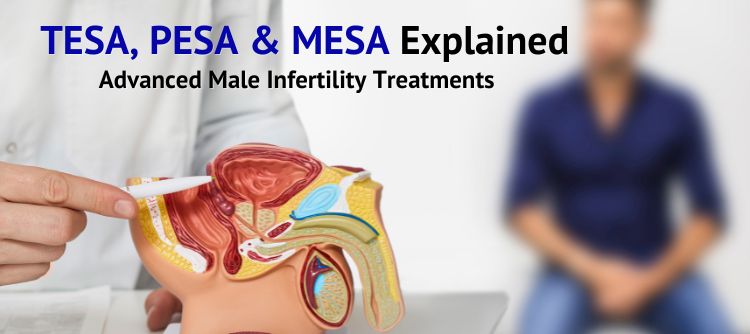
Understanding Male Infertility & Azoospermia
Male infertility usually comes down to a problem with either sperm production or sperm delivery. Common causes include low sperm count, poor sperm movement, abnormal shape, hormonal imbalance, varicocele, infection, or a blockage. The most challenging finding is azoospermia — the complete absence of sperm in the ejaculate. It affects around 1% of all men and up to 10–15% of men with fertility problems. There are two types, and this decides which technique is best:
- Obstructive azoospermia (OA): Sperm are produced normally but cannot travel out because of a blockage — often after a vasectomy, an infection, or an absent vas deferens.
- Non-obstructive azoospermia (NOA): The testicles make very little or no sperm. Even here, tiny pockets of sperm-producing tissue may exist and can sometimes be found surgically.
1
What Is Surgical Sperm Retrieval?
Surgical sperm retrieval (SSR) is a group of minor procedures that collect sperm directly from the epididymis or testicle when it cannot be obtained through normal ejaculation. The sperm is then used to fertilise the partner’s eggs in the lab, almost always through ICSI. It is recommended for men with azoospermia, a failed vasectomy reversal, ejaculation disorders, or very poor semen quality. Before choosing a technique, a proper evaluation — semen analysis, hormone tests, physical exam and often a scrotal ultrasound — tells the specialist whether the problem is obstructive or non-obstructive.
2
PESA – Percutaneous Epididymal Sperm Aspiration
PESA is one of the simplest, least invasive methods. It collects mature sperm from the epididymis (the coiled tube behind each testicle where sperm are stored). It is usually the first choice for obstructive azoospermia. How it works:
- Done under local anaesthesia as a day-care procedure.
- A fine needle draws a small amount of fluid from the epididymis.
- An embryologist checks the fluid for healthy, moving sperm.
- Good sperm are used immediately for ICSI or frozen for later.
- Takes just 10–20 minutes, no cuts or stitches, most men resume normal activity within a day.
3
TESA – Testicular Sperm Aspiration
TESA collects sperm directly from the testicular tissue instead of the epididymis. It is chosen when PESA is unsuccessful, or when sperm must be taken from the testicle itself — also useful for ejaculation failure. How it works:
- A minor procedure under local anaesthesia.
- A fine needle aspirates tiny tissue samples, often from more than one spot.
- The tissue is searched in the lab for viable sperm.
- Any sperm found is used for ICSI the same day or frozen.
- Quick, affordable, fast recovery. Being a “blind” needle technique, it may miss sperm in severe cases — which is why micro-TESE is preferred for many NOA patients.
4
Other Advanced Sperm Retrieval Techniques
A complete fertility centre offers the full range:
- MESA: Uses an operating microscope to collect large numbers of high-quality sperm — ideal for obstructive azoospermia and freezing.
- TESE: A small incision removes a piece of testicular tissue, yielding more sperm than a needle.
- Micro-TESE: The gold standard for non-obstructive azoospermia — under a high-powered microscope the surgeon removes only the healthiest tubules, giving the highest retrieval rates while removing the least tissue.
5
How Retrieved Sperm Is Used: The Role of ICSI
Sperm collected through PESA or TESA is usually very small in number — far too little for natural conception or IUI. This is where ICSI becomes essential: a single healthy sperm is injected directly into each egg, so even a handful of sperm can create embryos. The typical journey: the female partner undergoes stimulation and egg retrieval → sperm is collected (or thawed) the same day → eggs are fertilised with ICSI → embryos are cultured and transferred.
6
Success Rates of PESA & TESA
Success depends heavily on the diagnosis. In obstructive azoospermia, retrieval rates with PESA and TESA are very high — often above 90% — because sperm production is normal. In non-obstructive azoospermia, retrieval is harder, and micro-TESE gives the best chance, finding usable sperm in roughly 40–60% of carefully selected patients. Retrieving sperm is only the first step — final pregnancy also depends on the woman’s age, egg and embryo quality, and the lab’s skill.
7
Recovery, Risks & What to Expect
PESA and TESA are safe and well-tolerated. The procedure takes only minutes under local anaesthesia. Afterwards, most men feel only mild soreness, minor swelling or slight bruising that settles within a few days. Wearing scrotal support and avoiding heavy lifting helps. Serious complications are rare (minor bleeding, small hematoma, or infection). These needle procedures have no known long-term effect on sexual function or testosterone. Contact the clinic if you notice increasing pain, heavy swelling, fever or discharge.
8
Cost of PESA & TESA Treatment
PESA and TESA are among the more affordable options — they are quick, need only local anaesthesia, and involve no major surgery. In India they generally cost less than microsurgical techniques like MESA or micro-TESE. Since the sperm is almost always used with an IVF-ICSI cycle, the overall cost depends on the complete treatment. A personal consultation gives a clear, transparent estimate.
9
Why Choose Atharva Infertility Centre, Nashik
For over 18 years, Atharva Infertility Centre has been a trusted name in fertility care in Nashik and across Maharashtra, with more than 1,900 IVF babies born through our programme. Under experienced specialist Dr. Yeshwant Mane, our team offers the complete range — from diagnosis and semen analysis to PESA, TESA, TESE, micro-TESE and advanced IVF-ICSI — paired with a modern embryology lab and compassionate, personalised care.
10
Take Action Today
A diagnosis of azoospermia is no longer the end of the road to fatherhood. With an accurate diagnosis and an experienced team, PESA and TESA paired with IVF-ICSI make biological fatherhood possible for many men. Book a consultation today — call or WhatsApp +91 9309804330 — and take the first step towards your parenthood journey.
PESA vs TESA vs TESE vs Micro-TESE: Quick Comparison
Lorem ipsum dolor sit amet, consectetur adipiscing elit. Ut elit tellus, luctus nec ullamcorper mattis, pulvinar dapibus leo.
| Feature | PESA | TESA | TESE | Micro-TESE |
|---|---|---|---|---|
| Sperm source | Epididymis | Testicle (needle) | Testicle (incision) | Testicle (microscope) |
| Best for | Obstructive AZ | Obstructive AZ / failed PESA | When needle methods fail | Non-obstructive AZ |
| Anaesthesia | Local | Local | Local / sedation | General |
| Incision | No | No | Small | Small (precise) |
| Invasiveness | Very low | Low | Moderate | Moderate |
| Recovery | ~1 day | 1–2 days | A few days | A few days |
| Sperm yield | Moderate–high | Low–moderate | Higher | Highest in NOA |
Frequently Asked Questions
Q. Is PESA or TESA painful?
A. Both are done under local anaesthesia, so you may feel only slight pressure. Any soreness afterwards is minor and settles in a few days.
Q. Can retrieved sperm be frozen?
A. Yes. If enough healthy sperm are found, they can be frozen for future IVF-ICSI cycles.
Q. Which is better — PESA or TESA?
A. Neither is universally better. PESA is usually tried first for obstructive azoospermia; TESA is used when sperm must come from the testicle. Your doctor decides based on diagnosis.
Q. Do these procedures cause birth defects?
A. There is no evidence they increase birth-defect risk. Genetic testing is advised where relevant.
Q. What if no sperm is found?
A. Micro-TESE offers a further chance, especially in NOA. If retrieval is still unsuccessful, donor sperm remains a hopeful option.
Q. How soon can I return to work?
A. Most men return to normal activity within one to two days.
Q. Can the procedure be repeated?
A. Yes, safely, after a suitable gap if a fresh sample is needed later.
If you would like to understand your options, the caring specialists at Atharva Infertility Centre, Nashik are here to help. Book a consultation today — call or WhatsApp +91 9309804330 — and take the first step towards your parenthood journey.